
.png)
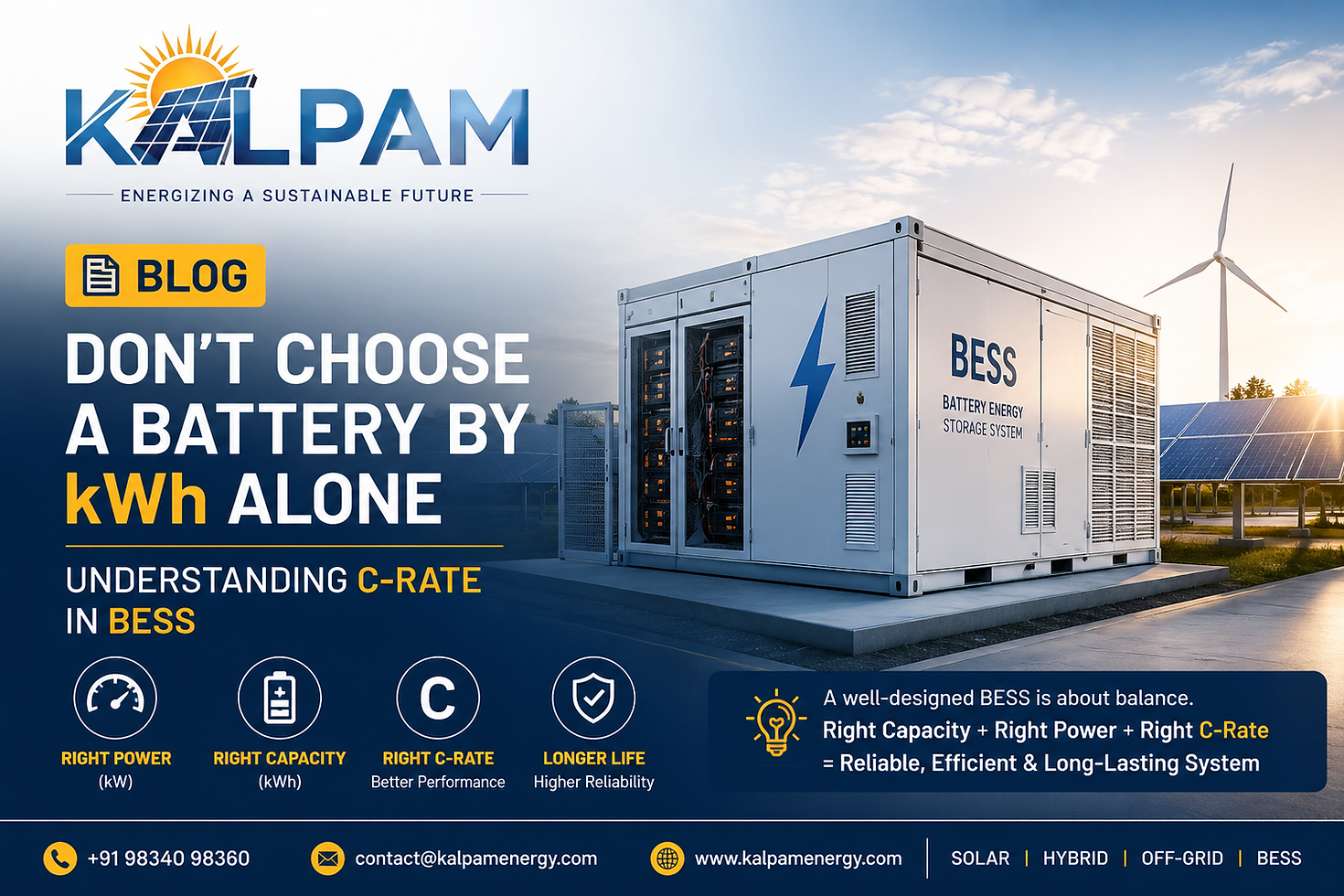
Don’t Choose a Battery by kWh Alone: Why C-Rate Matters in Solar & BESS

Why two 10 kWh batteries can perform completely differently
When selecting a battery for a solar, hybrid or Battery Energy Storage System (BESS), most people focus on one number:
“How many kWh is the battery?”
10 kWh?
20 kWh?
100 kWh?
Battery capacity is certainly important — but it tells you only how much energy the battery can store.
It does not tell you how quickly that energy can safely be delivered.
For that, we need to understand another important specification:
C-RATE
The C-rate can significantly influence:
- Maximum battery power
- Ability to handle heavy electrical loads
- Battery heating
- Cycle life
- System efficiency
- Battery degradation
- Inverter compatibility
- Overall return on investment
At KALPAM ENERGY, we believe a battery should not simply be selected according to its kWh capacity. It should be engineered according to the customer's actual load profile and operating requirement.
---
Capacity vs C-Rate: A Simple Example
Think of your battery as a water tank.
Battery Capacity = Size of the Tank
A larger tank stores more water.
Similarly, a:
10 kWh battery
can theoretically store approximately 10 kWh of electrical energy.
C-Rate = Size of the Outlet Pipe
The outlet determines how quickly water can leave the tank.
Similarly, the battery's C-rate indicates how quickly its stored energy can be charged or discharged relative to its rated capacity.
So:
Capacity tells us HOW MUCH energy is available.
C-rate helps tell us HOW FAST that energy can be delivered.
Both matter.
---
What Does 1C, 0.5C and 0.2C Mean?
Consider a:
10 kWh Battery
If its allowable discharge rate is 1C:
10 kWh × 1C ≈ 10 kW
The battery could theoretically deliver around 10 kW at that rate, subject to the manufacturer's current, voltage, BMS, temperature and operating limits.
At 0.5C:
10 kWh × 0.5C ≈ 5 kW
At 0.2C:
10 kWh × 0.2C ≈ 2 kW
This is why simply saying:
«“I have a 10 kWh battery.”»
doesn't fully describe what the battery system can do.
---
Two 10 kWh Batteries Are Not Necessarily Equal
Imagine two batteries:
Battery A
Capacity: 10 kWh
Continuous discharge capability: approximately 0.5C
Potential continuous output:
≈ 5 kW
Battery B
Capacity: 10 kWh
Continuous discharge capability: approximately 1C
Potential continuous output:
≈ 10 kW
Both may store approximately the same amount of energy.
But their power-delivery capability can be very different.
This distinction becomes extremely important in hybrid and off-grid systems.
---
kW and kWh Are Different
This is one of the most common misunderstandings in battery storage.
kWh = ENERGY
It tells us how much energy is stored.
kW = POWER
It tells us how much power can be supplied at a particular moment.
For example:
A customer may install a 10 kWh battery, but their simultaneous loads could include:
- Air conditioner
- Water pump
- Refrigerator
- Lighting
- Computers
- Other appliances
Suppose the combined instantaneous requirement reaches 7 kW.
If the battery system can continuously provide only 5 kW, having 10 kWh of stored energy does not automatically mean it can operate that entire 7 kW load from the battery.
The battery, BMS and inverter must all be capable of supplying the required power.
---
Why Not Simply Choose the Highest C-Rate?
It is tempting to think:
“Higher C-rate = Better battery.”
Not necessarily.
Higher discharge capability can be valuable where high power is genuinely required.
But unnecessarily aggressive charge/discharge operation can also mean greater:
- Current
- Internal heating
- Electrical stress
- Thermal-management requirements
- BMS demands
Battery ageing depends on many factors including cell chemistry, temperature, depth of discharge, state-of-charge range, charge/discharge rate and manufacturer-specific cell design.
Therefore, good engineering is not about selecting the largest number on the datasheet.
It is about finding the correct balance between POWER, ENERGY, LIFE and COST.
---
Why C-Rate Matters for Battery Life
Every charge-discharge cycle places electrochemical and thermal stress on a battery.
Operating a battery continuously near aggressive limits can increase heat generation and may accelerate degradation compared with operating it under moderate conditions.
However, C-rate alone does not determine battery life.
Battery lifespan is also influenced by:
Cell Chemistry + Temperature + Depth of Discharge + C-Rate + SOC Window + BMS Strategy + Cycle Count + Installation Environment
For LiFePO₄ batteries commonly used in stationary solar storage, proper system sizing and operating conditions are therefore extremely important.
---
Example: Home Hybrid Solar System
Consider a home with:
10 kW Hybrid Inverter
10 kWh Battery
A customer might assume:
10 kW inverter + 10 kWh battery = 10 kW battery backup
That assumption can be wrong.
Suppose the battery's permitted continuous discharge power is only:
5 kW
Even though the inverter is rated for 10 kW, the battery may not be capable of continuously supplying the full inverter rating from battery power alone.
The complete system must therefore be checked:
Battery → BMS → DC Current → Inverter → Load
The weakest limit in this chain can determine actual performance.
---
Battery Runtime Also Needs to Be Calculated
Suppose:
Battery capacity = 10 kWh
Usable energy after considering operating limits = 9 kWh
Average load = 3 kW
Simplified theoretical runtime:
9 kWh ÷ 3 kW = 3 hours
But real-world runtime can differ because of:
- Inverter losses
- Battery efficiency
- Temperature
- BMS limits
- Depth-of-discharge settings
- Changing loads
- Battery ageing
Therefore, backup time should be calculated from the actual load profile, not merely advertised battery capacity.
---
C-Rate Becomes Even More Important in Commercial BESS
For commercial and industrial energy storage, the distinction between POWER (kW) and ENERGY (kWh) becomes critical.
Consider a:
100 kWh BESS
At an effective 0.5C discharge rate, approximately:
50 kW
of power corresponds to that rate.
At 1C:
100 kW
corresponds to that rate.
Therefore, two projects using the same 100 kWh battery capacity could be engineered for completely different applications.
One may be optimized for longer-duration energy shifting.
Another may be designed for higher-power discharge over a shorter period.
---
Solar + BESS Must Be Designed as One System
A properly engineered hybrid or BESS project should consider:
Solar PV Generation
↓
Customer Load Profile
↓
Day vs Night Consumption
↓
Peak Demand
↓
Required Backup Duration
↓
Battery kWh
↓
Required Battery kW
↓
Allowable C-Rate
↓
BMS Current Limits
↓
Hybrid/PCS Inverter Rating
↓
Battery Operating Strategy
This is why professional BESS sizing cannot be based on battery capacity alone.
---
What Should You Check Before Buying a Battery?
Don't ask only:
“How many kWh?”
Also check:
1. Usable battery capacity
2. Nominal battery voltage
3. Continuous charge current
4. Continuous discharge current
5. Maximum/peak discharge current and permitted duration
6. Continuous discharge power
7. Recommended operating C-rate
8. Depth of Discharge (DoD)
9. Cycle-life test conditions
10. Battery chemistry
11. BMS protections
12. CAN/RS485 communication compatibility
13. Compatible inverter/PCS models
14. Operating temperature
15. Warranty terms and throughput conditions
16. Expansion/parallel capability
Most importantly:
Ask whether the battery can actually support your required load.
---
Bigger Battery Doesn't Automatically Mean Better System
A successful energy-storage project is not:
Maximum kWh + Maximum C-rate + Maximum inverter size
It is:
RIGHT CAPACITY + RIGHT POWER + RIGHT C-RATE + RIGHT INVERTER + RIGHT CONTROL STRATEGY
For one customer, the priority may be long overnight backup.
For another, it may be high instantaneous power.
For a commercial facility, the goal may be peak-demand management or time-of-day energy shifting.
For an off-grid site, reliability and autonomy may be more important than anything else.
Each application requires a different design philosophy.
---
KALPAM ENERGY — ENGINEER THE BATTERY, DON'T JUST BUY THE CAPACITY
At KALPAM ENERGY PVT. LTD., our approach to solar and battery storage focuses on the complete energy profile rather than a single specification.
Before sizing a hybrid or BESS solution, the engineering process should evaluate:
Load Profile → Peak Demand → Solar Generation → Backup Requirement → Battery Power → Battery Capacity → C-Rate → Inverter/PCS → Energy Management Strategy
Because in energy storage:
kWh tells you how much energy you have.
kW tells you how much power you need.
C-rate helps connect the two.
---
Planning a Solar + Battery or BESS Project?
KALPAM ENERGY PVT. LTD.
Solar | Hybrid | Off-Grid | Battery Energy Storage Systems
📞 +91 98340 98360
KALPAM ENERGY — Engineering Energy for a Smarter future


Comments